Main takeaways
- A qubit is the basic unit of a quantum computer: a blend of 0 and 1 while computing, a plain 0 or 1 when read.
- Each added qubit doubles the combinations a machine can hold, but qubits are fragile: a stray field or a temperature change causes errors.
- The number to look for is the qubit count together with the error rate. The best machines err about once per thousand operations, NIST says.
- Press releases count physical qubits. Error correction combines many of them into one more reliable “logical” qubit: Google’s team used 101.
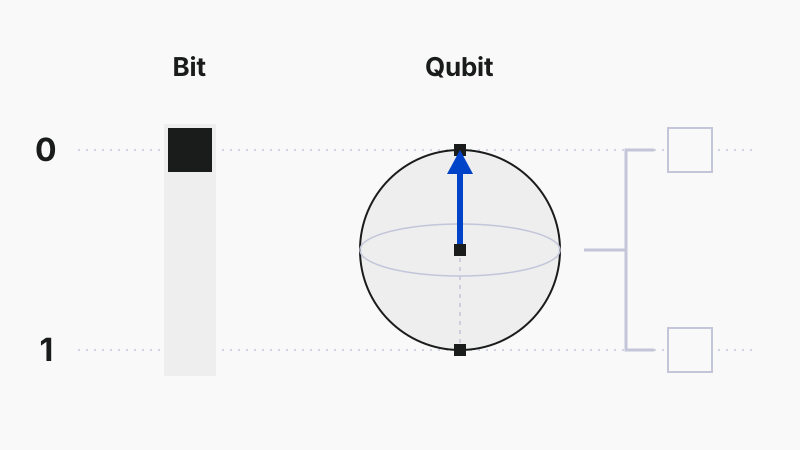
A qubit is the basic unit of information in a quantum computer, the way a bit is in an ordinary one. A bit is always 0 or 1. A qubit can be set to a blend of the two while the machine computes, and it gives a plain 0 or 1 only when it is read.
Think of a bit as a light switch: up or down. A qubit is closer to an arrow that can point anywhere on a globe, with 0 at the north pole and 1 at the south pole. The comparison stops being true in two places. Nobody can see where a qubit’s arrow points: reading it forces the arrow to a pole, and all that comes out is that pole’s 0 or 1. And the globe describes one qubit alone: once qubits are linked, the picture breaks down.
How it works
- Start with something small that has two states. The National Institute of Standards and Technology (NIST), the U.S. measurement agency, uses the example of an atom with a low and a high energy level. One is called 0, the other 1. Tiny superconducting circuits and particles of light can play the same role.
- Turn the arrow. Pulses of laser light or electromagnetic signals move the qubit from 0 to any blend of 0 and 1. Physicists call the blend a superposition.
- Link qubits together. Linked qubits share one state, which is called entanglement. Two qubits can hold a blend of four combinations of 0s and 1s, three hold eight, four hold 16: each added qubit doubles the number, NIST says.
- Read. Each qubit gives 0 or 1, at random, and the blend is gone. The closer the arrow was to a pole, the more likely that pole’s answer.
Qubits are fragile. A stray electric or magnetic field, a change in temperature or a cosmic ray can ruin the blend, NIST says, and the calculation then contains an error. The best quantum computers today hold hundreds of linked qubits and make an error about once in every thousand operations, according to the same page, updated on May 28, 2026.
What people get wrong
“A qubit is 0 and 1 at the same time.” Not in a way anyone can read. A read returns one value, never both. The blend behind it is what a widely used introduction calls “a kind of hidden information”.
“A quantum computer tries every answer at once.” NIST’s page says that, contrary to popular belief, superposition does not let a quantum computer run an efficient brute-force search over every possible solution. The read at the end extracts only a little information, so a program has to be built to make that little the useful part.
Who is building it
Hardware companies have chosen four main objects as qubits.
- Superconducting circuits. Chips cooled to near absolute zero. Rigetti Computing (RGTI) says its systems run on superconducting qubits kept in dilution refrigerators, the fridges that reach those temperatures. IQM Quantum Computers (IQMX) says it builds superconducting quantum computers. Google, part of Alphabet (GOOGL), says its hardware focuses on superconducting qubits.
- Trapped ions. Electrically charged atoms held in a vacuum chamber and steered with lasers. IonQ (IONQ) says its qubits are ionized ytterbium atoms. Quantinuum (QNT) also builds trapped-ion machines.
- Neutral atoms. Uncharged atoms held in place by laser beams. Infleqtion (INFQ) says its Sqale system traps and controls individual atoms with lasers. Pasqal (PSQL) and QuEra Computing, which is private, both say they use rubidium atoms.
- Photons. Particles of light. PsiQuantum, which is private, says its qubits are single photons, on chips made in a commercial semiconductor foundry. Xanadu (XNDU) says it builds quantum computers using photonics.
D-Wave Quantum (QBTS) builds a different kind of machine, an annealer, which it says is designed for optimization.
What it means for investors
- Read the qubit count together with the error rate. The error rate is usually given as two-qubit gate fidelity: how often an operation on a pair of qubits gives the right result. Rigetti said on November 10, 2026 that its 108-qubit system reached 99.5% median two-qubit gate fidelity, which is about one error in 200 operations. That is the company’s own measurement. NIST’s figure for the best machines is about one error in a thousand.
- A real improvement is more qubits at the same or a better fidelity. Caltech’s primer notes that the more qubits a machine has, the more likely it is to make errors. A bigger count with no fidelity beside it says little.
- The count in a press release is physical qubits. Error correction combines many physical qubits into one more reliable “logical” qubit. In a paper that Google said was published in Nature in December 2024, its team used 101 physical qubits to hold one logical qubit.
- The qubit type sets the equipment and the trade-off. Superconducting chips need fridges, and ions and atoms need vacuum chambers and lasers. Ion qubits hold their state for a long time but compute slowly, NIST says. Superconducting qubits compute fast and are more fragile.
- A roadmap is a claim about closing a large gap. For a task such as breaking codes, a quantum computer may need millions of qubits that run error-free, NIST says, against hundreds today. The next target in Rigetti’s release is a system of more than 300 qubits at about 99.7% fidelity by mid-2028.
Last checked 2026-11-11
Sources
- NIST, “Quantum Computing Explained”, updated May 28, 2026: https://www.nist.gov/quantum-information-science/quantum-computing-explained
- Caltech Science Exchange, “What Is Quantum Computing?”: https://scienceexchange.caltech.edu/topics/quantum-science-explained/quantum-computing-computers
- Andy Matuschak and Michael Nielsen, “Quantum computing for the very curious”: https://quantum.country/qcvc
- Microsoft Learn, “The qubit in quantum computing”: https://learn.microsoft.com/en-us/azure/quantum/concepts-the-qubit
- R. Acharya and others, “Quantum error correction below the surface code threshold”, Nature 638 (2025), preprint: https://arxiv.org/abs/2408.13687
- Google, “Meet Willow, our state-of-the-art quantum chip”, December 9, 2024: https://blog.google/technology/research/google-willow-quantum-chip/
- Rigetti Computing, third-quarter 2026 results release, November 10, 2026, as carried by The Quantum Insider: https://thequantuminsider.com/2026/11/11/rigetti-q3-2026-results-quantum-computing-roadmap/
- Company technology pages: Rigetti https://www.rigetti.com/what-we-build, IQM https://www.iqm.tech/, Google https://quantumai.google/quantumcomputer, IonQ https://ionq.com/technology, Quantinuum https://www.quantinuum.com/products-solutions/quantinuum-systems, Infleqtion https://infleqtion.com/quantum-computing/, Pasqal https://www.pasqal.com/technology/, QuEra https://www.quera.com/neutral-atom-platform, PsiQuantum https://www.psiquantum.com/quantum-computing, Xanadu https://www.xanadu.ai/photonics, D-Wave https://www.dwavequantum.com/learn/quantum-computing/