Main takeaways
- Superposition is a qubit holding a weighted blend of 0 and 1. The blend ends when the qubit is read, which gives one plain value.
- It does not let a machine try every answer at once: searching a million entries still takes in the order of 1,000 quantum steps.
- Interference does the computing: a program makes the routes to wrong answers cancel and the routes to the right one add up.
- The number to watch is how long a blend lasts against one operation’s length: Rigetti gives 10 microseconds and 50 to 70 nanoseconds.
In a superposition, the weights are what matter. They set the odds of each result: a qubit weighted heavily toward 0 will most often read 0, and sometimes 1. The blend holds until the qubit is read or disturbed, and then it is gone.
Touch a pond at two points at once. Ripples spread from each point and overlap into one pattern. That pattern is a superposition of two waves, Caltech’s primer says, and the states of a quantum object combine in the same way. The comparison stops being true at the water. A qubit’s waves are mathematical, Caltech says: equations that give those odds. A read returns one result, at random, according to NIST, the U.S. measurement agency.
How it works
The smallest example takes one qubit and one operation applied twice. Physicists call an operation a gate, and this one the Hadamard gate. Quantum Country walks through it.
- Start at 0. The qubit has a definite value.
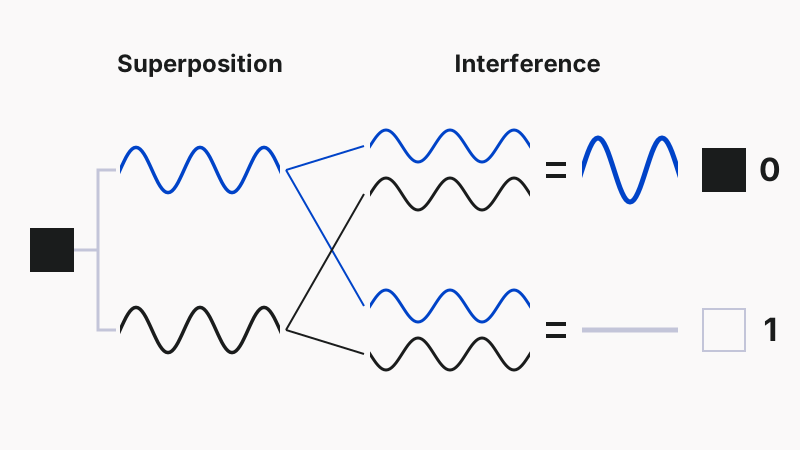
- Make the blend. One operation turns the 0 into an equal blend of 0 and 1. Read now, the qubit gives 0 half the time and 1 half the time: a coin toss, which computes nothing.
- Apply the same operation again. The qubit does not end up more scrambled. It comes back to 0, every time. Unlike the sides of a coin, the two parts of a blend each carry a sign, like the crest and the trough of a wave. Each part contributes to both possible results. The two contributions to 1 have opposite signs and cancel. The two contributions to 0 have the same sign and add up. This is called interference, and it is where the computing happens.
- Do it with many qubits. A program follows the same pattern, IBM’s primer says: prepare a superposition over many combinations of 0s and 1s, then run operations so that many outcomes cancel and others are amplified. The amplified outcomes are the answer.
The blend has to survive until the last operation. A disturbance from outside forces the qubit back to a plain 0 or 1, NIST says. The time a qubit can hold its blend is its coherence time.
What people get wrong
“A quantum computer tries every answer at once.” If it did, finding one name among a million in random order would take one step. Lov Grover’s 1996 paper says otherwise. An ordinary computer has to look at half the names, 500,000, for an even chance of finding the right one. A quantum computer needs a number of steps in the order of the square root of the total, which is 1,000 here, and the paper says no quantum method can do much better. The gain comes from tuning the steps so that the right result reinforces itself and the others do not.
“The blend is a 0 or a 1 that nobody has looked at yet.” A coin under a cup is already heads or tails. If a qubit in a blend were secretly 0 or 1, the second operation would leave it at even odds. It gives 0 every time.
Who is building it
Every quantum computer has to hold superpositions long enough to finish a program. Specification sheets give two times. T2 is how long a superposition lasts. T1 is how long a qubit set to 1 stays there before it decays to 0, IBM’s documentation says.
- Trapped ions. Electrically charged atoms, held in a vacuum and steered with lasers. IonQ (IONQ) says its ion qubits have coherence times measured in minutes.
- Superconducting circuits. Chips cooled to near absolute zero. Rigetti Computing (RGTI) lists a median T2 of 10 microseconds (millionths of a second) and a median T1 of 25 microseconds for its 108-qubit Cepheus-1-108Q system. Google, part of Alphabet (GOOGL), said on December 9, 2024 that T1 times on its 105-qubit Willow chip were approaching 100 microseconds, about five times its previous generation.
- Neutral atoms. Uncharged atoms, held in place by laser beams. QuEra Computing, which is private, uses rubidium atoms and says some choices of the atom’s two states hold a blend for more than one second.
What it means for investors
- Read coherence time against gate time. Every gate of a program has to finish before the qubits lose coherence, IonQ’s glossary says, so what counts is how many gates fit in that time. Rigetti’s release of November 10, 2026 gives gate times of 50 to 70 nanoseconds (billionths of a second). A microsecond is 1,000 nanoseconds, so its listed T2 of 10 microseconds is the length of about 140 to 200 such gates. For trapped ions the same sum cannot be done from these pages. IonQ’s glossary gives a coherence time and no gate time. Rigetti’s release says its gates are about 10,000 times faster than trapped-ion systems, which is a claim about gate speed only. The comparison that counts needs both numbers, measured on the same system.
- A real improvement holds across the whole machine. Rigetti’s figures are medians over a system’s qubits. A figure for a chip’s best qubit says less about a program that runs on all of them.
- A count of states is not computing power. Each added qubit doubles the combinations a machine can hold in superposition, NIST says. That describes step 2 above, the coin toss. The value is in a method whose interference produces the answer. Peter Shor’s 1995 paper gave one for factoring large numbers, a problem used as the basis of encryption systems.
- The next dated target. Rigetti’s release targets a system of more than 300 qubits with gate speeds below 60 nanoseconds by mid-2028. It gives no coherence time for that system.
Last checked 2026-11-11
Sources
- Caltech Science Exchange, “What Is Superposition and Why Is It Important?”: https://scienceexchange.caltech.edu/topics/quantum-science-explained/quantum-superposition
- NIST, “Quantum Computing Explained”, updated May 28, 2026: https://www.nist.gov/quantum-information-science/quantum-computing-explained
- Andy Matuschak and Michael Nielsen, “Quantum computing for the very curious”: https://quantum.country/qcvc
- IBM, “What is quantum computing?”, updated April 2, 2026: https://www.ibm.com/think/topics/quantum-computing
- Lov K. Grover, “A fast quantum mechanical algorithm for database search”, 1996, preprint: https://arxiv.org/abs/quant-ph/9605043
- Peter W. Shor, “Polynomial-Time Algorithms for Prime Factorization and Discrete Logarithms on a Quantum Computer”, 1995, preprint: https://arxiv.org/abs/quant-ph/9508027
- IBM Quantum documentation, “Get QPU information” (definitions of T1 and T2): https://quantum.cloud.ibm.com/docs/en/guides/qpu-information
- IonQ, glossary (coherence time, gate speed): https://ionq.com/resources/glossary
- Rigetti Computing, “What we build” (system performance tables): https://www.rigetti.com/what-we-build
- Rigetti Computing, third-quarter 2026 results release, November 10, 2026, as carried by The Quantum Insider: https://thequantuminsider.com/2026/11/11/rigetti-q3-2026-results-quantum-computing-roadmap/
- Google, “Meet Willow, our state-of-the-art quantum chip”, December 9, 2024: https://blog.google/technology/research/google-willow-quantum-chip/
- QuEra Computing, “Neutral-atom platform”: https://www.quera.com/neutral-atom-platform